
RTO Audit Basics

Understanding ASQA Audits, Self-Assurance & Internal Reviews
This practical online course provides RTO administration staff, managers and owners the foundational knowledge and tools to confidently participate in ASQA audits and conduct structured internal reviews.
Aligned to the 2025 Standards for Registered Training Organisations, RTO Audit Basics covers the full audit cycle — from understanding when and why audits are triggered, to reading an audit report, meeting self-assurance obligations, and running your own internal reviews using our included checklist suite.

This course does require participants have an understanding of the VET sector and regulation, including:
1
Overview of the Australian VET sector
2
Role and function of RTOs
RTO administration staff who want to understand the compliance environment they work in
RTO managers and team leaders who want their team to conduct consistent internal reviews
Compliance officers seeking a practical foundation in ASQA audit processes and self-assurance activities
RTO CEOs and directors wanting to ensure they are aware of the obligations and requirements in relation to ASQA audits and self-assurance to monitor staff performance, be able to respond to audit questions, have confidence in the responses to the Annual declaration on compliance and avoid potential breaches.
New starters in an RTO who want an understanding of ASQA audits and self-assurance activities
Who is the course for?
3
Key regulatory bodies
4
The 2025 Standards for RTOs
If you are wanting to undertake the course and do not have this foundation knowledge, please contact us first and we can provide the relevant information and course to develop this knowledge.
What you will learn with us
The Australian VET regulatory framework and ASQA's role
Types of ASQA audits — registration audits, performance assessments, and what triggers each
How to read and interpret an ASQA audit report
Self-assurance obligations under the 2025 Standards for RTOs
How to plan and conduct structured internal reviews
How to use the included self-assessment checklist suite in your own RTO
On completion:
All participants who successfully complete RTO Audit Basics receive:
A certificate of completion
A suite of self-assessment checklists — practical tools built for conducting internal reviews in your RTO, ready to use immediately.
On completion:
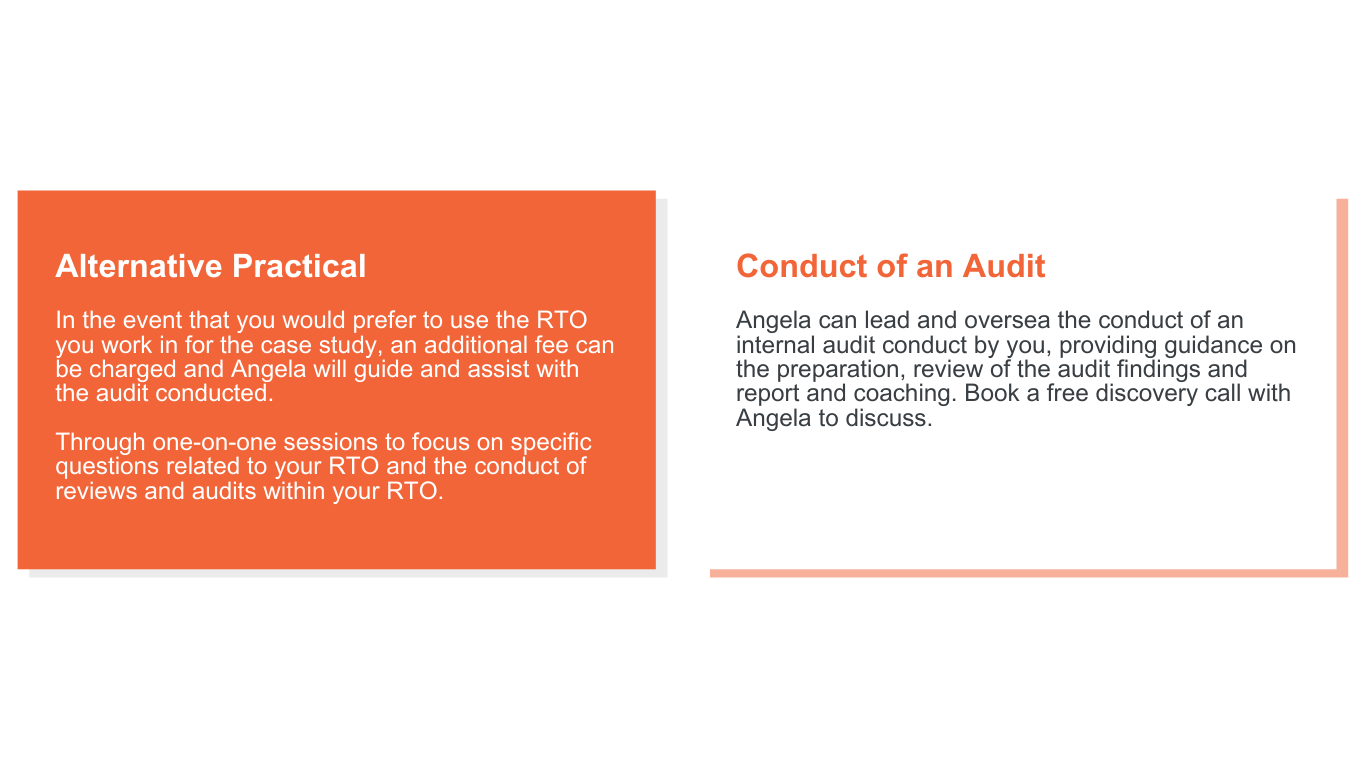
The program has been designed using examples of RTO documentation.
All participants who successfully complete the course will receive a suite of checklists for use in the conduct of audits and a certificate of completion.

FAQs
Q: Do I need prior compliance experience to do this course?
A: You need a basic understanding of the VET sector and the role of RTOs. If you're new to the sector, contact us first and we can point you to the right foundation course.
Q: Is this course aligned to the 2025 Standards for RTOs?
A: Yes. RTO Audit Basics is fully aligned to the 2025 Standards for Registered Training Organisations, which came into effect on 1 July 2025.
Q: What kind of checklists are included?
A: On completion you receive a suite of self-assessment checklists designed for conducting internal reviews against the 2025 Standards. They are based on real RTO documentation and ready to use in your next review cycle.
Q: Can my employer pay for this course?
A: Yes. This course is designed as employer-sponsored professional development. Contact us if you need an invoice or enrolment for multiple staff members.
Q: How long does the course take?
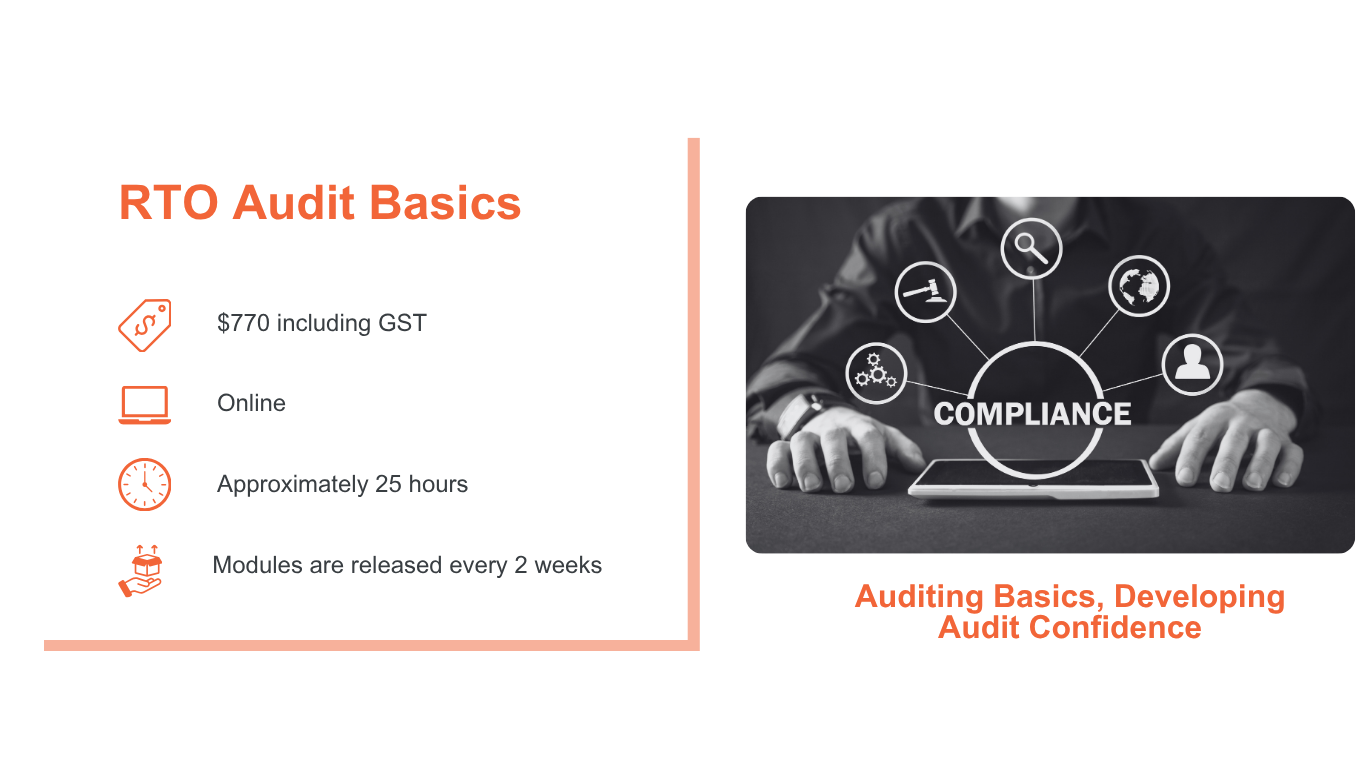
A: The course is self-paced and online. The content is broken up into modules with activities for you to complete. It is estimated that the course takes 25 hours.
Q: What is self-assurance and why does it matter?
A: Self-assurance is the ongoing process RTOs use to monitor their own compliance and quality against the Standards — separate from and in addition to ASQA audits. Under the 2025 Standards, self-assurance is an explicit obligation, not optional.
Professional Development · RTO Compliance
Empowering RTO Staff: Compliance through Skill Development
Imagine, the RTO is due for renewal. ASQA send through a 3-page list of evidence required for the desktop audit. You have 5 days in which to compile the evidence.
What is your reaction? Can you do this? Are you confident that your administration staff have the skills to maintain accurate records and ensure self-assurance activities? Do they know what is to be retained and why?
While learner outcomes remain a core focus, it is equally important for RTOs to empower their staff — particularly administration staff — whose expertise underpins the organisation's ability to demonstrate compliance. The reputation and ongoing registration of any RTO depend not just on meeting regulatory requirements, but on cultivating a staff culture where quality and compliance are woven into daily operations.
Administrators play a crucial role, serving as the first line of defence in implementing, recordkeeping and monitoring compliance requirements. Their knowledge, or lack of, of compliance frameworks will directly impact the RTO's ability to demonstrate compliance.
Administration teams equipped with auditing skills are instrumental in detecting non-compliances early, recommending practical solutions, and supporting self-assurance practices. Their expertise will ensure that in the event of an audit, the required document is available and checks have been implemented to ensure early detection of opportunities for continuous improvement.
Not what you’re looking for?