Accredited Course vs Nationally Recognised Training: What's the Difference?
These two terms get treated as though they're the same. They're not. An accredited course is itself a form of nationally recognised training, and understanding why clears up a source of confusion for anyone setting up or operating an RTO.
The distinction isn't whether something "counts" as nationally recognised. It's about how a qualification or course comes to exist in the first place, and who owns it once it does. In this blog we will clarify the difference..
Nationally Recognised Training Is the Umbrella, Not One of the Two Options
Nationally recognised training (NRT) describes any training delivered by a Registered Training Organisation that leads to a qualification under the Australian Qualification Framework (AQF), regardless of which state/territory or RTO it is completed through. It comes from one of two sources: a nationally endorsed training package, or an accredited course. Both sit under the NRT umbrella. Neither is a lesser or better version of the other.
Training Package Qualifications: Nationally Endorsed, Publicly Owned
A training package qualification is developed and endorsed at a national level by industry, currently administrated Jobs and Skills Councils, and built from units of competency and assessment requirements aligned to the Australian Qualifications Framework. Training packages are government owned, which means any RTO can apply to have a qualification added to its scope without paying to licence the content itself. This is what most people picture when they think training via a registered training organisation.
Accredited Courses: Developed to Fill a Genuine Gap
An accredited course is developed by an individual or organisation, the course owner, specifically to address a skills or knowledge gap that no existing training package covers. ASQA will not accredit a course where the same outcome could already be achieved through a training package, the gap and industry need has to be real.
For an accredited course the course owner pays for the accreditation process, retains the copyright, and licenses the course to RTOs for delivery, which usually means a licensing cost to the RTO that a training package qualification doesn't carry. Accredited courses are governed by the Standards for VET Accredited Courses 2021, and there's naming convention worth knowing.

How to Tell Them Apart in Practice
Two quick, reliable checks work in almost every case. First: if the code starts with NAT, then it is accredited. Check the code on training.gov.au rather than assuming based on the title alone. The second: when on training.gov.au if you are unable to see the content of units with the NAT code, then it is accredited.
Why This Distinction Actually Matters for Your RTO
If you're setting up or expanding an RTO's scope, adding a training package qualification to your scope is generally more straightforward and doesn't carry a licensing cost, since the content is publicly available to any RTO. Adding an accredited course means budgeting for a licence fee to the course owner, and confirming the accreditation is current and that you're an approved RTO for that specific course, since not every RTO holding a broad scope is automatically approved to deliver every accredited course in existence.
If you're setting up an RTO for the first time, this is exactly the kind of detail worth getting right before it becomes part of your application. We've covered the broader cost picture of RTO registration in our guide on how much it costs to register an RTO in Australia which is worth reading alongside this if you're still working through the setup process.
If you want to develop an accredited course to address a training need before applying for RTO status.
Frequently Asked Questions
What is the difference between an accredited course and nationally recognised training in Australia?
Nationally recognised training is the umbrella term for training that leads to nationally recognised outcomes when delivered by an authorised RTO. It includes both qualifications from nationally endorsed training packages and accredited courses. An accredited course is therefore a type of nationally recognised training, developed to address an identified skills or knowledge gap that is not already covered by a training package.
Is an accredited course as valuable as a training package qualification?
Yes, in terms of national recognition. Both are listed on the national register and both are treated as nationally recognised training once delivered by an approved RTO. The difference lies in ownership and development, not in the standing of the outcome itself.
How do I know if a course is a training package qualification or an accredited course?
Search the course code on training.gov.au. The listing will identify whether it is a training package qualification or an accredited course. As a quick guide, accredited course codes generally begin with “NAT”, while training package qualification codes use the relevant training package or industry prefix. The register also shows the course’s current status and the RTOs approved to deliver it.
Does an RTO have to pay to deliver an accredited course?
It depends on the course owner’s licensing arrangements. An RTO may need to pay a licence or delivery fee to use an accredited course, although some course owners may allow delivery at no cost. The RTO must also have the course on its scope of registration and meet any approval or contractual requirements set by the owner.
Can any course be turned into an accredited course?
Not all courses can be accredited. A course can only be accredited if it addresses a demonstrated industry, enterprise, education, legislative or community need that is not already met by an existing training package qualification. Delivering the course first as non-accredited training can help test its content, assessment approach and suitability for learners and industry.
Feedback, completion data and other evidence gathered during delivery can then inform the accredited course design and help demonstrate the need for accreditation, although accreditation is not guaranteed. The course must still satisfy the applicable accreditation standards and be approved by the relevant course-accrediting body.
What is the process for accrediting a course with ASQA?
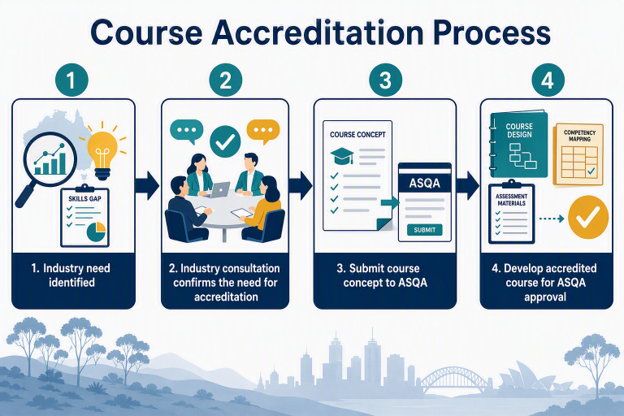
ASQA’s initial course accreditation process begins with a VET course concept. The concept must identify the proposed course outcomes, demonstrate a genuine training need and show that the outcomes are not already covered by a nationally endorsed training package qualification. If ASQA determines that the concept is eligible, the course can be developed in consultation with relevant stakeholders and documented against the Standards for VET Accredited Courses 2021 and the Australian Qualifications Framework. The course owner then submits the initial accreditation application and full course documentation, pays the applicable fees and responds to any requests for further information or rectification during ASQA’s assessment. ASQA will make the accreditation decision after completing its assessment. If you would like support with the course concept or accreditation application, book a discovery call to discuss your proposed course.
How long is an accredited course accredited for, and does it need to be re-accredited?
ASQA accredits a VET course for a period of up to five years, with its start and expiry dates recorded on the national register. To keep the course nationally recognised beyond its expiry date, the course owner must apply for renewal and demonstrate that the need for the course continues, review and redevelop the course where required, and show that it still meets the Standards for VET Accredited Courses 2021 and the Australian Qualifications Framework. ASQA requires the renewal application to be submitted at least 90 days before the current accreditation expires and recommends lodging the Intention to renew accreditation form about six months before expiry so there is time to complete the process.
What governs the standards for accredited courses in Australia?
Course accreditation is governed by the Standards for VET Accredited Courses 2021, administered by ASQA, alongside the Australian Qualifications Framework, which sets the qualification levels both training package qualifications and accredited courses must align to.
Get the Detail Right From the Start
Understanding exactly which pathway a qualification or course sits under matters more once you're the one responsible for delivering it compliantly.
If you're working through scope additions, course accreditation, or setting up a new RTO and want this kind of detail confirmed properly for your specific situation, book a consultation with our team, or get in touch to talk it through.
Looking to get a course accredited? Download the Course Accreditation Readiness Checklist to assess your course concept and prepare for the accreditation process: https://www.rtoconsultant.com.au/accredited-courses/
This article provides general information about nationally recognised training in Australia and is not a substitute for advice specific to your RTO's scope and circumstances.