
Course Accreditation

An accredited course is a course that ASQA has approved to meet an industry need that isn't filled by an existing nationally recognised qualification or training package.
Anybody can develop a course for accreditation, including industry bodies, employers and RTOs. Once it is accredited, an RTO can deliver it if they own it or have the course owner's permission, and have it on their scope of registration. In Victoria and Western Australia, some courses are accredited by the VRQA or the WA Training Accreditation Council instead.
We Can Assist In The Application For The Accreditation Or Reaccreditation Of A Course
- Determine whether an existing course or qualification already exists.
- Guide you in the consultation process so you have sufficient evidence of industry support and need for the course.
- Guide you through the accreditation process, advising what is required and when.
- Take your existing training material, or work with you, to write the accreditation document in the required language and format.
- Complete the application and accreditation documents.
- Guide you through reaccreditation and prepare the course accreditation documents.
- Assist in responding to non-compliances if an accreditation application is unsuccessful.
Find Out How We Can Help You Get Your Course Accredited
Tell us about your course and we'll tell you whether accreditation is the right path and what is involved.
Phone: 1800RTO101
Is Course Accreditation Right For You?
ASQA will only accredit a course if it is satisfied the need exists and the course doesn't duplicate the outcomes of an endorsed training package.
Accreditation May Be Right If…
- Industry needs training that no current training package qualification or skill set covers
- You can show industry support and a genuine need for the course
- Your course would lead to a nationally recognised outcome under the AQF
It Is Probably Not Right If…
- An existing training package qualification or unit already covers the same outcomes
- You only need to add an existing qualification to your RTO's scope
How ASQA Course Accreditation Works
Submitting a new course to ASQA is called initial accreditation. It follows five steps, and we support you at every one.
-
Step 1
VET Course Concept
What ASQA requires: You submit a short course concept so ASQA can check the course is eligible before you invest in full development. Once it has been assessed you have up to 6 months to complete and submit the course.
How we help: We check whether an existing qualification already covers your idea, and shape the concept so it is clear about the need and the outcomes.
-
Step 2
Course Development
What ASQA requires: You write the course using ASQA's national course document template, and show it meets the Standards for VET Accredited Courses 2021 and the AQF, with evidence of industry need and consultation.
How we help: We guide your industry consultation and write the course document, either from scratch or from your existing training material.
-
Step 3
Course Submission
What ASQA requires: You lodge the application form, the completed course document and the supporting documents. A separate application and assessment fee applies for each course.
How we help: We complete the application and accreditation documents and check them before they go to ASQA.
-
Step 4
Application Assessment
What ASQA requires: ASQA assesses the application against the Standards and the AQF. It may seek technical advice from industry, and it tells you if anything doesn't comply.
How we help: We help you respond to any non-compliances quickly and clearly.
-
Step 5
Decision
What ASQA requires: If the course is accredited, ASQA confirms it in writing, including any conditions. RTOs then apply to add the course to their scope.
How we help: We help you plan what comes next, including renewal well before the accreditation period ends.
What Does Course Accreditation Cost?
There are two parts to the cost. ASQA charges a course concept lodgement fee and an accreditation assessment fee, with a separate application and fee for each course. ASQA is reviewing its fees for 2026/27, so always check the current schedule on ASQA's fees and charges page.
Our consulting fee depends on how much you need us to do: developing the whole course, guiding you through the process, or helping with a rectification. Book a discovery call and we'll talk through your course, the likely effort and the cost.
What Our Clients Say
ASQA can't provide consultancy services or recommend consultants, so it matters that you choose one with a proven record. RTO Consulting was founded in 1999 by Angela McGregor, who has more than 20 years' experience as an RTO consultant and has set up and managed her own RTO.
Angela and the team at RTO consulting was a great asset to us during our accreditation process. We found them to be a wealth of knowledge and support through the whole accreditation process. We could not have become an RTO without them. Thanks RTO Consulting!
We used RTO Consulting to develop two accredited courses. This is not something we could have achieved without Angela McGregor. Angela is extremely knowledgeable and easy to work with. She delivered her services to us with minimal fuss and extracted the information she needed in an efficient manner. At all times Angela gave us the confidence that the desired outcome would be achieved when others had told us it was impossible. We have no hesitation in recommending RTO Consulting to anyone who is embarking on the development of an accredited course.
Angela worked with me to address some major rectifications for an accredited course we submitted to ASQA. It was a combination of her knowledge of ASQA's requirements and also how to structure my course for vocational education that got the submission over the line. I think next time I will engage Angela before making my submission. A great experience. Angela is knowledgeable and professional... and most importantly very patient.
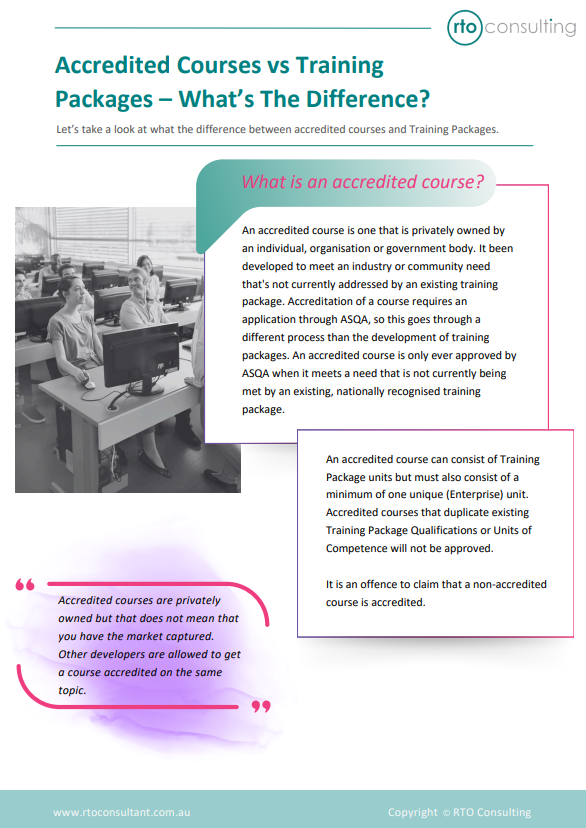
Accredited Courses vs Training Packages – What’s The Difference?
Discovering the difference between accredited courses and Training Packages is essential. Download our checklist and guide to gain deeper insights and learn more about these educational pathways.
Course Accreditation FAQs
What is an accredited course?
An accredited course is a course that ASQA has approved to meet a skills or knowledge gap that isn't covered by a training package. Accreditation confirms the course meets the Standards for VET Accredited Courses 2021 and the Australian Qualifications Framework (AQF), and it can then be delivered by RTOs that have it on their scope.
How long does course accreditation take?
Allow time before you apply for the course concept, industry consultation and writing the course document. Once ASQA has assessed your course concept you have up to 6 months to complete and submit the course. After you submit, ASQA aims to accredit the course within 6 months. A course that is well developed against the Standards and the AQF moves through assessment more smoothly.
How much does course accreditation cost?
ASQA charges a course concept lodgement fee and an accreditation assessment fee, and a separate application and fee applies for each course. ASQA is reviewing its fees for 2026/27, so check its current fees page. Our consulting fee depends on whether you need full course development, guidance through the process, or help responding to ASQA. Book a discovery call and we'll talk you through the scope and cost.
Do I need to be an RTO to get a course accredited?
No. Anybody can develop a course for accreditation. However, an accredited course can only be delivered by an RTO that owns the course or has the course owner's permission, and that has the course on its scope of registration.
What is the difference between an accredited course and a training package qualification?
Training package qualifications are nationally endorsed and can be delivered by any RTO that has them on scope. An accredited course is developed by a course owner to meet a need that training packages don't cover. ASQA will only accredit a course if it is satisfied the need exists and the outcomes do not duplicate endorsed training package outcomes.
How do I register a course?
People use “register a course” to mean two different things. If you have a new course that doesn't exist in a training package, you apply to have it accredited, and that is what this page covers. If you are an RTO that wants to deliver an existing qualification or accredited course, you add it to your scope of registration. Contact us and we'll point you to the right service.
Can ASQA recommend a consultant?
No. ASQA says it cannot provide consultancy services or recommend consultants, although it points applicants to lists published by industry bodies such as Velg and ITECA. Choose a consultant with proven experience of the course accreditation process and ask for references from past clients.
What if ASQA says my course doesn't meet the requirements?
If an application doesn't meet all the requirements, ASQA explains the reasons. We can help you work out what needs to change, rewrite the affected parts of the course document and prepare your response.
Which regulator accredits my course?
ASQA accredits courses nationally, but courses that will only be delivered in Victoria or Western Australia may be accredited by the VRQA or the WA Training Accreditation Council. Contact us if you aren't sure which applies to you.


