What does it Cost to Set Up an RTO?
A breakdown of the fixed and variable costs of becoming a Registered Training Organisation in Australia.
Setting up a Registered Training Organisation (RTO) is one of the most rewarding moves you can make in the vocational education sector — but it is also a significant financial commitment. Before you lodge an application with the Australian Skills Quality Authority (ASQA), it pays to understand exactly where your money goes. The cost of setting up an RTO is rarely a single number; it is a combination of fixed costs you pay to get established and variable costs that scale with the size and scope of your operation.
For most new providers offering a modest scope of nationally recognised qualifications, a realistic budget lands somewhere between $30,000 and $80,000 to reach registration — and more for CRICOS (international student) providers. This guide breaks those costs down so you can plan with confidence.
Fixed costs of setting up an RTO
Fixed costs are the largely predictable, up-front investments required to establish your RTO and get through the initial registration process. You pay these regardless of how many students you eventually enrol, which is why they form the backbone of any startup budget.
ASQA initial registration fees
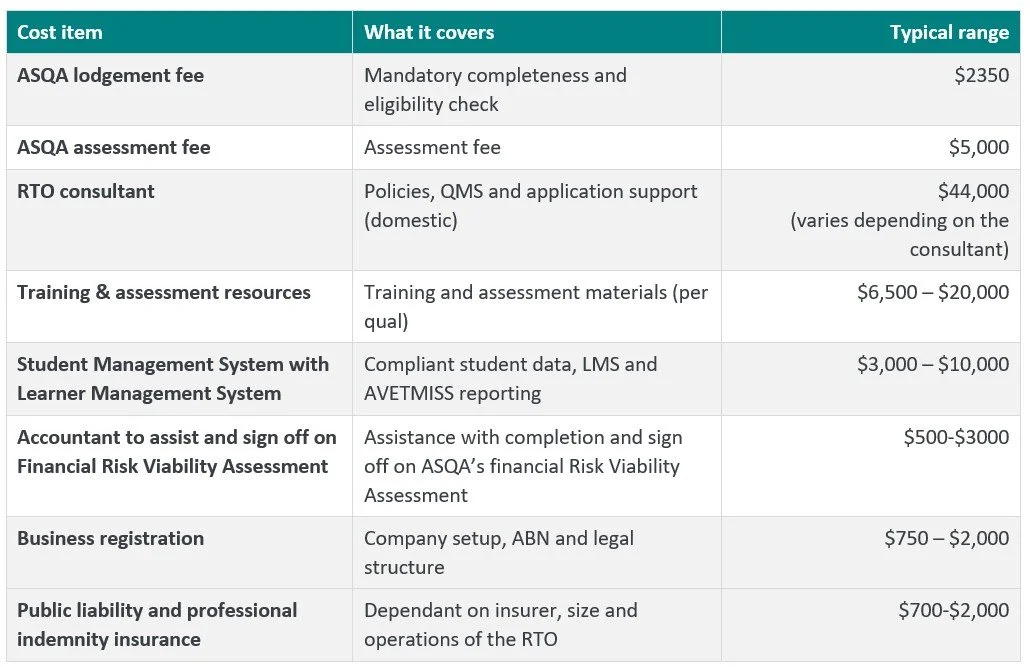
ASQA charges two mandatory fees to assess a new application. An application lodgement fee of $2350 covers the initial completeness and eligibility check. This is followed by an application assessment fee starting at $5,000.
Training and assessment resources
Every qualification on your scope needs pre-use reviewed learning and assessment materials that map to the training package requirements. Purchasing or developing these resources generally costs $6,500 to $20,000 per qualification. However, this price will vary if you have the materials developed for you by a content writer, one of your team or even yourself. A word of warning, many of the off the shelf training and assessment materials require extensive rewriting and it is often more affordable, quicker and a better outcome, if you develop them in house.
Systems, business setup and initial infrastructure
You will also need core systems and a legal entity in place before you can operate. These often include a one-off establishment costs include company and business registration, a Student Management System (SMS) and, for online or blended delivery, a Learning Management System (LMS).
Variable costs of running an RTO
Variable costs shift with the size, scope and delivery model of your RTO. They begin during setup and continue for the life of your registration, so they matter just as much as your up-front spend when you model long-term viability.
Additional scope on your ASQA application
The base ASQA assessment fee only covers a limited scope. Beyond that, you pay $200 for each application and $1,100 assessment fee.
ASQA annual registration charge
Once registered, every RTO pays an Annual Registration Charge (ARC). This is tiered according to the number of qualifications on your scope and your total student enrolments. A small provider (up to four qualifications and fewer than 100 students) pays around $1,500 a year, while larger providers with broad scope and high enrolments can pay $20,000 or more annually.
Premises, staffing and operating costs
Ongoing operating expenses are where budgets vary most. Trainer and assessor wages, premises rent, marketing, and software subscriptions all scale with your delivery model. A provider delivering in the workplace might spend a few thousand dollars setting up delivery, whereas a face-to-face provider leasing commercial premises can face rent of $70,000 to well over $150,000 per year depending on location, resource requirements and space.
What is the total cost to set up an RTO?
Pulling the fixed and variable elements together, a straightforward domestic RTO with a narrow scope can reach registration for roughly $30,000 to $80,000. Providers with a broad scope, physical premises, or CRICOS registration should budget well beyond $100,000. The single biggest variables are the number of qualifications you register, your delivery model, and whether you engage experienced support to get it right the first time.
How to keep your RTO setup costs under control
Register a focused scope: Start with a tight, deliverable scope — you can add qualifications later once cash flow is established.
Get the application right first time: A rejected or heavily rectified application is the most expensive outcome of all; expert support usually pays for itself.
Choose resources wisely: Buying validated resources is almost always cheaper and faster than building them from scratch.
Model your delivery mode early: Fully online delivery avoids premises costs and can dramatically reduce your fixed outlay.
Planning your RTO? RTO Consulting helps aspiring providers scope, budget and lodge a compliant application with confidence. Talk to us before you spend a dollar — a clear plan is the cheapest investment you'll make.
Frequently asked questions
How much does it cost to set up an RTO in Australia?
Most domestic RTOs cost between $30,000 and $80,000 to reach registration, combining ASQA fees, consultant support, resources and systems. CRICOS and large-scope providers typically exceed $100,000.
What are the ASQA fees to register an RTO?
A new applicant pays an $2,350 lodgement fee plus an assessment fee of $5,000.
Are there ongoing costs after registration?
Yes. Every RTO pays an Annual Registration Charge which varies depending on the number of training products and the number of students per year. For more information visit ASQA’s website https://www.asqa.gov.au/for-providers/fees-charges/annual-registration-charge
Additional variable operating costs include as trainer wages, premises, insurance, software, ASQA audits, and marketing.
Renewal registration is $1500 and the assessment fee is $3000.